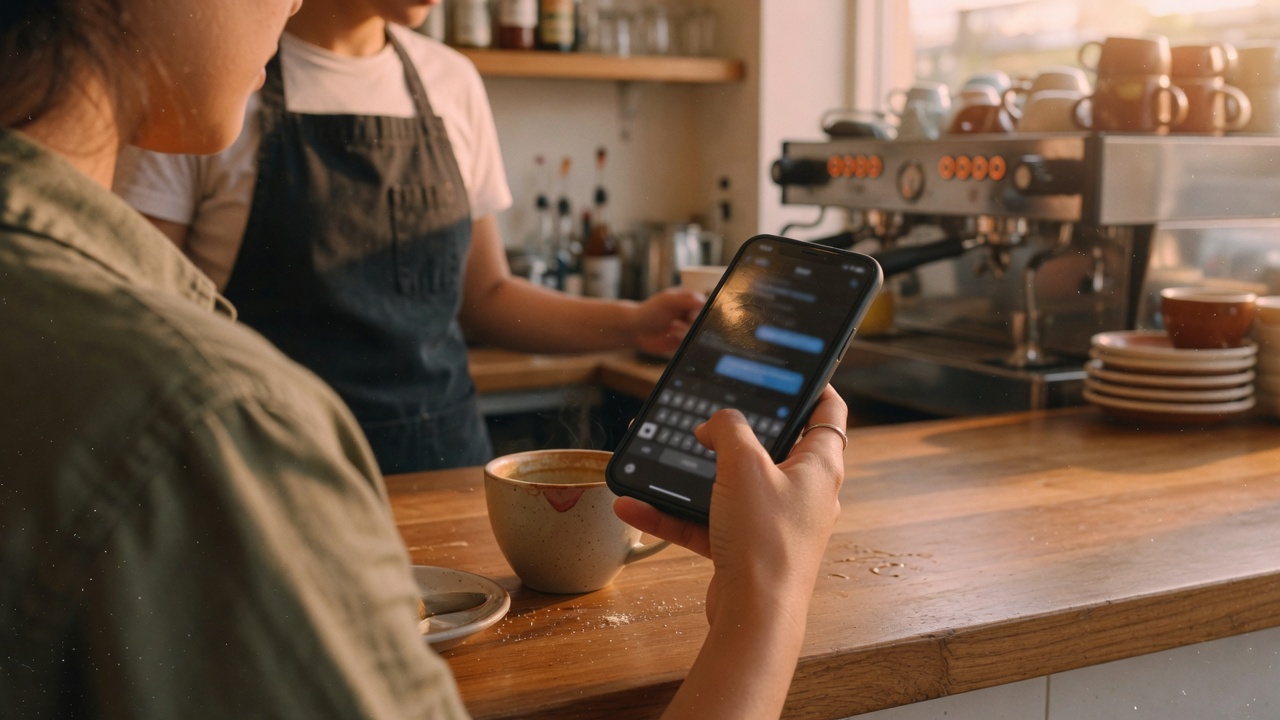


If you're asking customers for reviews via email and wondering why your conversion rate is low, the channel might be the problem. SMS and email are not interchangeable for review requests. They behave very differently, and understanding the difference will change how you build your request strategy.
The Open Rate Gap Is Enormous

SMS is opened far more often, and far faster, than email. The practical gap is large: more people see a text, and they see it while the visit is still fresh.
Email that sits unopened for an hour is often never opened. For review requests, where timing matters (see: the 1-to-3 hour post-service window), SMS almost always reaches people when the experience is still recent.
Conversion Rate Comparison by Channel
Open rates are one thing. Conversions are what matter.
Across consumer service industries, SMS review requests convert better than email from the same customer base. Measure your own request-to-review rate by channel instead of assuming a published range.
The SMS advantage is driven by three factors:
- Immediacy. The message appears on a screen someone is already looking at, often within minutes of the service.
- Friction. A direct review link in a text takes one tap to open. Email requires opening an app, finding the message, clicking through, and often navigating a longer message.
- Personal context. Text messages feel like personal communication. A request via text reads differently than a request via an email newsletter-style layout.
Compliance Requirements You Can't Ignore
SMS marketing is governed by the Telephone Consumer Protection Act (TCPA) in the United States. The rules are specific and the penalties for violations are real.
What TCPA requires for SMS review requests:
- Prior express written consent from the customer to receive text messages from you. A checkbox at booking, a signature on an intake form, or a consent field in your POS system all work. Verbal consent is not sufficient for marketing messages.
- Your business name identified in every message.
- An opt-out mechanism (typically "Reply STOP to unsubscribe").
- No messages to numbers on the Do Not Call registry.
Violations can result in fines of $500 to $1,500 per message. This isn't theoretical. Class action lawsuits under TCPA are common, and small businesses have been targeted.
Email is governed by CAN-SPAM, which is less restrictive. You need an unsubscribe mechanism, your physical address, and honest subject lines. Transactional emails (including post-purchase review requests) have more flexibility than marketing emails.
Build compliance into your intake process, not as an afterthought.
When Email Wins
SMS isn't always the right choice. Email outperforms for specific scenarios:
B2B services. If your customers are businesses (accounting clients, IT service customers, commercial contractors), email is the expected channel for post-service communication. A text message can feel informal or unprofessional in these contexts.
Complex, high-consideration services. Customers who just spent $15,000 on a kitchen renovation may prefer a more formal communication channel. Email lets you include more context, photos of the finished work, and a more detailed request.
Longer sales cycles. For services where the relationship spans weeks or months, email keeps a communication thread that SMS doesn't.
Older demographics. In certain industries serving older customers, email remains the more comfortable and expected channel for follow-up communication.
The Case for Dual-Channel Delivery
The strongest review request strategy isn't SMS or email. It's SMS and email, deployed strategically.
A practical dual-channel sequence:
- Send SMS within 1 to 3 hours of service completion.
- Wait 48 hours. If no review appears, send a follow-up email. Email as a follow-up rather than a primary channel works because it catches customers who missed or dismissed the text, and the email format allows for slightly more context.
This approach usually collects more reviews than SMS-only campaigns, because it catches people who missed or dismissed the text.
The key is suppressing the email follow-up if a review has already been left. Nothing is more tone-deaf than asking for a review someone already left. Your review request system needs to monitor new reviews and suppress follow-up messages automatically.
Building Your Request Stack
If you're starting from zero, here's the practical decision tree:
- Consumer-facing, transactional services (restaurants, salons, auto shops, contractors): Start with SMS as your primary channel. Add email as a 48-hour follow-up.
- Professional services and B2B: Email as primary. SMS optional for clients who have explicitly consented and with whom you have a closer relationship.
- Healthcare: SMS can work but requires extra care around consent documentation. Many practices find email easier to keep compliant.
The channel matters less than the consistency. A business that sends review requests by email every single time will outperform a competitor who occasionally sends a text when they remember to. Whatever channel you choose, automate it so it runs without relying on human memory.
Laudy supports both SMS and email review requests with built-in TCPA compliance tools and dual-channel automation. Start your free trial at Laudy and set up your request system in under 20 minutes.